
In This Article
For the first time in what feels like an eternity, the relentless climb of U.S. home prices is finally hitting the brakes. Government data just dropped, and it confirms what many of us have been feeling: the housing market heading into 2026 is a completely different beast than the frenzy of the last few years. We're not financial advisors, just your friendly neighbors who've spent hundreds of hours digging through the reports to figure out what this shift really means for regular folks. Whether you're a Gen Z grad dreaming of your first home, a recent buyer nervously watching your equity, or a seller wondering if you missed the peak, this is the story you need to pay attention to.
After years of double-digit price hikes and brutal bidding wars, the U.S. housing market has officially entered a new era of normalization. The Federal Housing Finance Agency (FHFA) just released its latest report, showing that from October 2024 to October 2025, U.S. home prices rose just 1.7%. To put that in perspective, it's the slowest annual growth rate we've seen in over a decade, since the market was just beginning its recovery from the 2008 crash. The days of homes appreciating by 15-20% year-over-year are, for now, firmly in the rearview mirror.
This slowdown isn't a crash, but it is a crucial correction. It's a market catching its breath after a historic sprint. For years, rock-bottom mortgage rates and a severe lack of inventory created a pressure-cooker environment. Now, with mortgage rates settling into a more normal range and inventory slowly starting to build, the power dynamic is shifting away from sellers and creating a sliver of opportunity for exhausted buyers. In this article, we'll break down what the data says, what this means for different generations of buyers and sellers, and how you can navigate this changing landscape as we head into 2026.
The Great Housing Market Cooldown
The headline number—1.7% annual growth—tells the main story, but the details reveal an even more interesting picture. The slowdown has been building all year. In fact, the FHFA's report revised September's numbers downward, from a flat 0.0% to a slight decline of -0.1%. This indicates that the market is not just cooling; in some months, it's actually taking a step back.
This cooldown is a direct result of two major forces: rising inventory and stabilizing mortgage rates. According to a comprehensive 2025 review by Redfin, the number of homes for sale was up a staggering 18.3% compared to last year. More choices for buyers means less desperation and fewer bidding wars. At the same time, mortgage rates, after spiking above 7% at the start of the year, have settled into a more manageable range around 6.3-6.6%. While still high compared to the pandemic-era lows, this stability has allowed buyers to adjust their budgets and re-enter the market with more confidence.
Key Takeaway: The housing market slowdown is real and it's driven by data. A massive 18.3% increase in homes for sale and more stable mortgage rates have ended the era of frantic bidding wars, giving buyers a fighting chance for the first time in years.
A Tale of Two Markets: Regional Winners and Losers
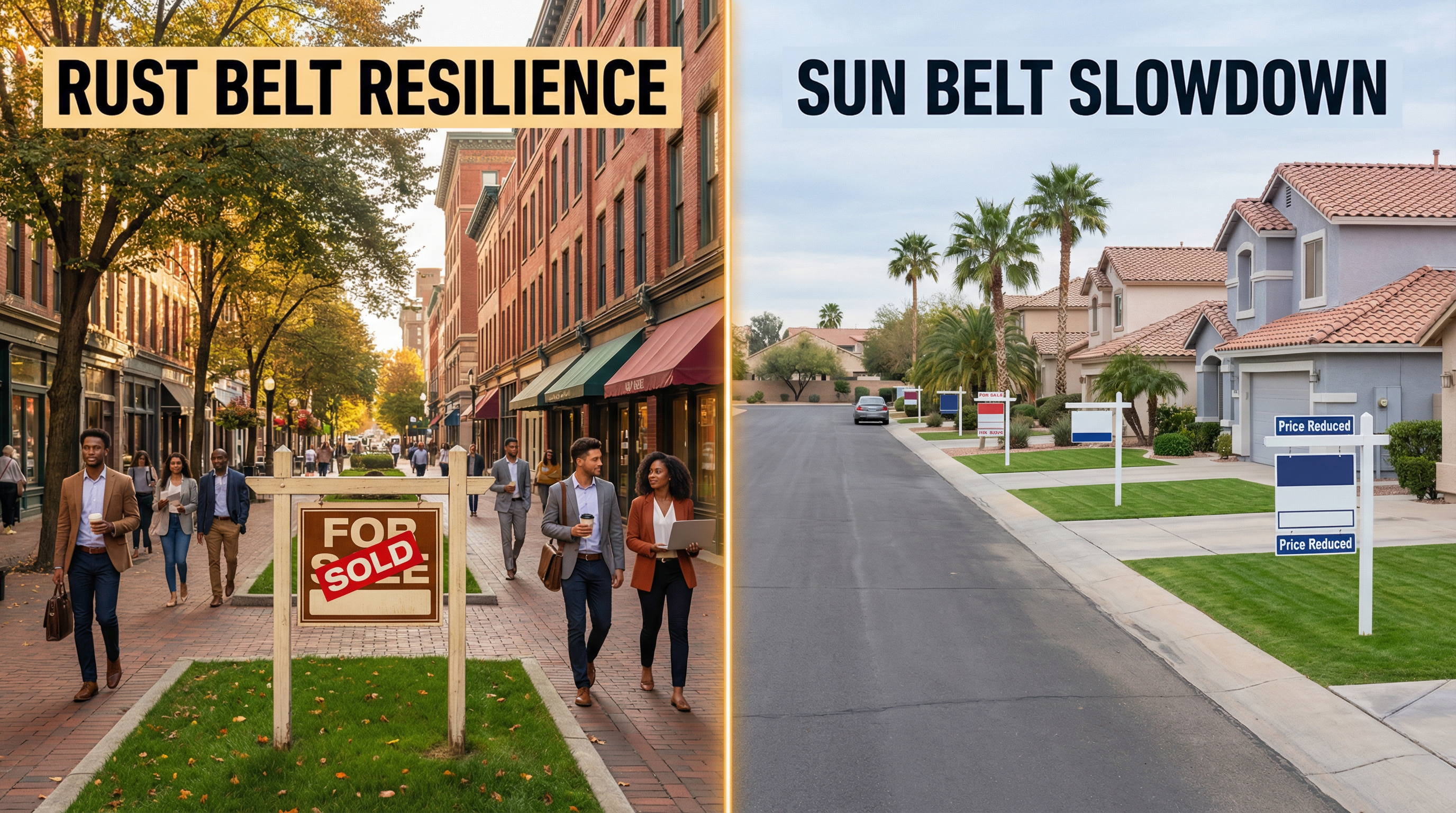
While the national picture shows a clear cooling trend, the story on the ground varies dramatically depending on where you live. This isn't one housing market; it's hundreds of local ones, each with its own unique dynamics. The data reveals a stark divide between the once-hot Sun Belt and the steady Rust Belt.
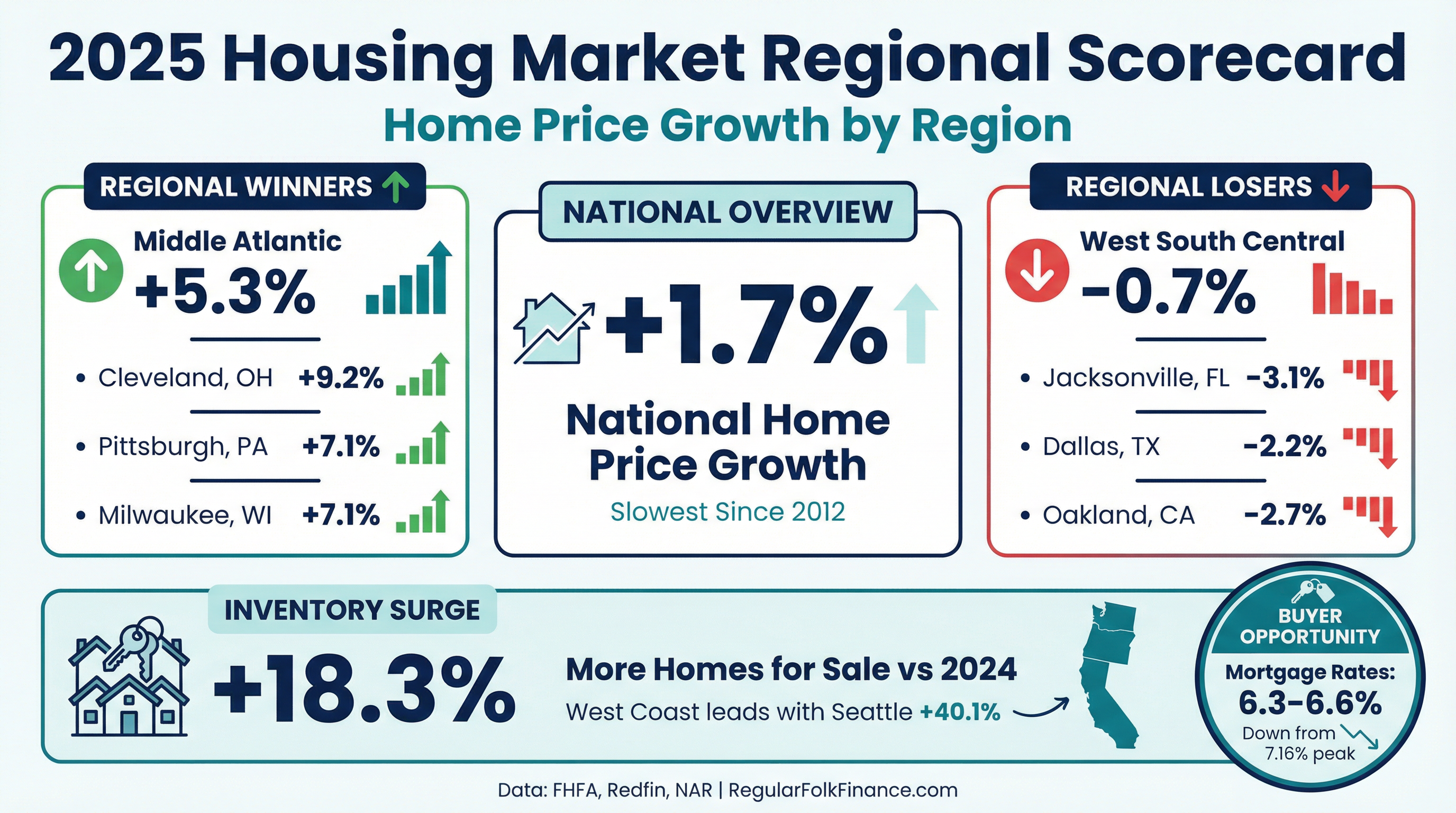
The slowdown has been most pronounced in the areas that saw the most explosive growth during the pandemic. According to the FHFA data, the West South Central region (including Texas and Oklahoma) actually saw prices decline by -0.7% year-over-year. Redfin's metro-level data paints a similar picture, with former boomtowns like Jacksonville, FL (-3.1%) and Dallas, TX (-2.2%) seeing the biggest price drops.
On the flip side, more traditionally stable markets in the Northeast and Midwest are showing remarkable resilience. The Middle Atlantic region (NJ, NY, PA) led the nation with +5.3% annual price growth. Cities like Cleveland (+9.2%) and Pittsburgh (+7.1%) saw some of the strongest appreciation in the country.
| Region / Metro | 12-Month Home Price Change | |---|---| | Top Performers | | | Middle Atlantic Region | +5.3% | | Cleveland, OH | +9.2% | | Pittsburgh, PA | +7.1% | | Milwaukee, WI | +7.1% | | Bottom Performers | | | West South Central Region | -0.7% | | Jacksonville, FL | -3.1% | | Dallas, TX | -2.2% | | Oakland, CA | -2.7% |
This divergence is critical. If you're in a Rust Belt city, the market still feels competitive. If you're in a Sun Belt city, you have more negotiating power than you've had in years.
What This Means for Gen Z Just Getting Out of College
For the first time in your adult life, there's a glimmer of hope. The 1.7% price growth is significantly slower than wage growth, which means your ability to save for a down payment is actually improving. According to Redfin, wages grew faster than housing costs in 2025 for the first time since 2016. This is your window.
The Opportunity: Affordable Rust Belt cities like Detroit (median price $202,739) and Cleveland (median price $243,830) are your best bet. You can find homes for a fraction of the coastal cost, allowing you to build equity and escape the rent trap.
The Challenge: Even in these affordable markets, competition for starter homes is still high. And because prices have been rising so fast in these areas, you need to be careful not to overpay. It's more important than ever to get pre-approved for a mortgage to understand your budget and lock in your rate before market conditions shift again.
| Metro | Median Home Price | |---|---| | Most Affordable | | | Detroit, MI | $202,739 | | Cleveland, OH | $243,830 | | Pittsburgh, PA | $250,250 | | St. Louis, MO | $280,294 | | Most Expensive | | | San Jose, CA | $1,617,658 | | San Francisco, CA | $1,522,535 | | Anaheim, CA | $1,198,636 |
What This Means for Recent Buyers (2022-2024)
If you bought a home in the last few years, you're probably feeling a mix of emotions right now. You locked in during peak prices, likely with a mortgage rate in the high 6s or even 7s. Now, you're watching prices flatten and rates inch down, and it's natural to wonder if you made a mistake.
Here's the honest truth: Your home's value isn't going to skyrocket like it did for people who bought in 2019. You may be sitting on minimal equity gains, or in some Sun Belt markets, your home might even be worth slightly less than what you paid for it. This can feel frustrating, but it's not a disaster.
The Silver Lining: You own a home. You're building equity with every mortgage payment, even if the market isn't helping. And as rates continue to ease, you may have a golden opportunity to refinance and significantly lower your monthly payment. A drop from 7% to 6% on a $400,000 mortgage could save you over $250 a month. For the latest on where rates are headed, see our breakdown of the Fed's December 2025 rate decision.
The Risk: If you need to sell in the next few years, you could face a loss. The transaction costs of selling (agent fees, closing costs) can easily eat 8-10% of your home's value. If the market hasn't appreciated enough to cover that, you could walk away with less than you put in.
Key Takeaway: For recent buyers, the name of the game is patience. Focus on building your financial stability, explore refinancing options, and avoid selling unless absolutely necessary. This market slowdown is also a reminder of the importance of a stable financial foundation, something we discussed in our article on the economic uncertainty caused by Trump's 2025 tariffs.
The Inventory Story: Where Are Homes Piling Up?
The 18.3% jump in housing inventory is one of the most significant statistics of 2025, but it comes with a major catch. The increase isn't uniform. In pricey coastal markets that saw a mass exodus during the pandemic, inventory has come roaring back. Seattle saw a massive 40.1% increase in homes for sale, with other West Coast cities like Las Vegas (+38.0%), Anaheim (+36.7%), and Oakland (+35.4%) close behind.
However, in more affordable markets, the story is the opposite. Inventory in San Francisco actually decreased by 0.1%, while cities like Chicago (+2.9%) and Philadelphia (+6.8%) saw only modest gains. This means that while the national numbers look promising for buyers, if you're shopping in an affordable, in-demand area, you're still facing a competitive market.
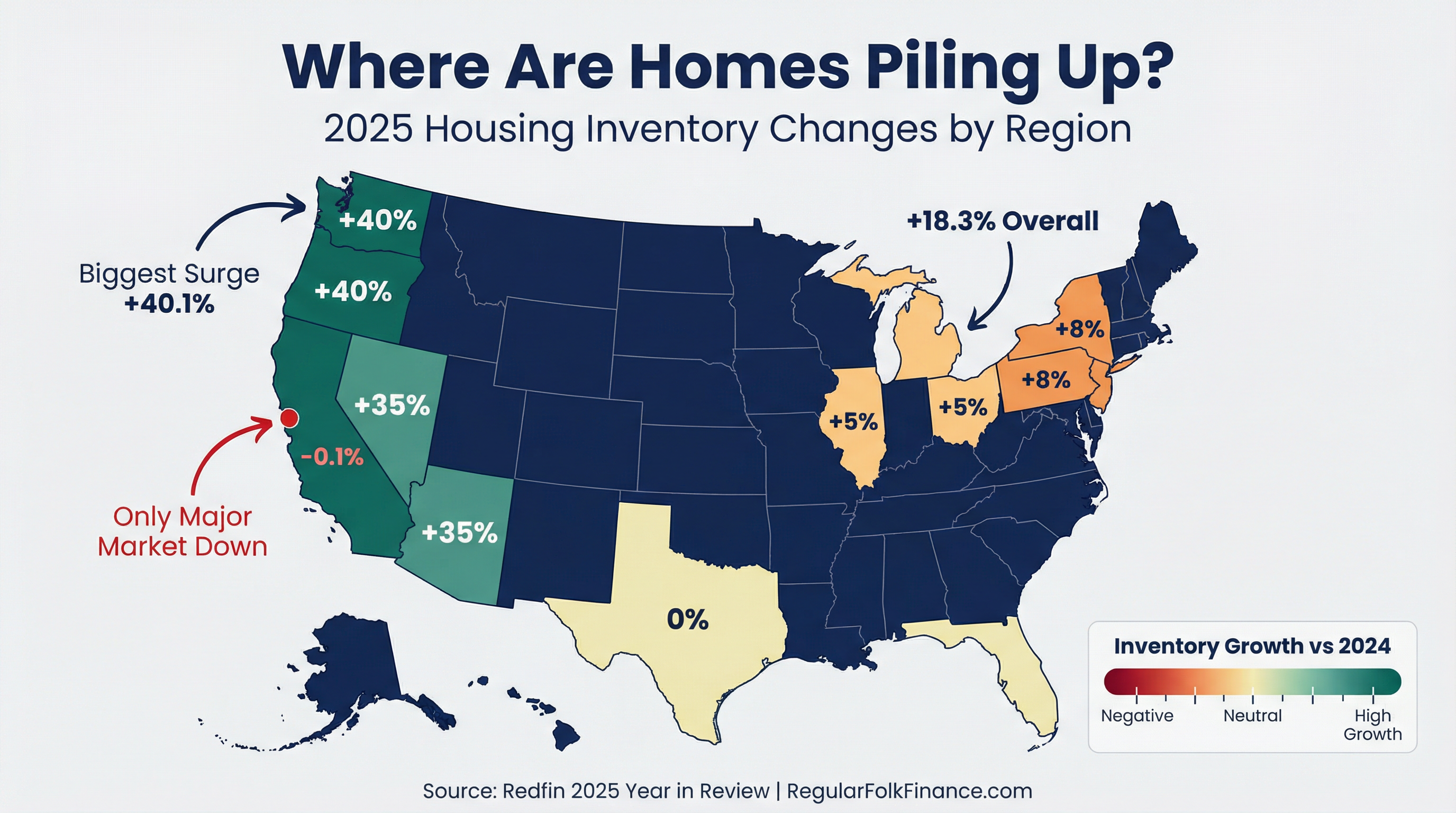
| Metro | Inventory YoY Change | |---|---| | Biggest Increases | | | Seattle, WA | +40.1% | | Las Vegas, NV | +38.0% | | Anaheim, CA | +36.7% | | Oakland, CA | +35.4% | | San Diego, CA | +32.7% | | Tightest Markets | | | San Francisco, CA | -0.1% | | Chicago, IL | +2.9% | | Philadelphia, PA | +6.8% | | Minneapolis, MN | +7.9% |
This inventory imbalance has a direct impact on how long homes stay on the market. In fast-moving markets like San Jose (17.3 days) and Seattle (19.3 days), homes are still selling in under three weeks on average. This is a world away from the national average of 48.5 days.
The Macro-Economic Picture: A Market in Transition
This housing slowdown doesn't exist in a vacuum. It's part of a broader economic transition that includes ongoing trade policy uncertainty and inflation concerns. The National Association of Realtors (NAR) reported that pending home sales (a forward-looking indicator) actually jumped 3.3% in November, the strongest performance in nearly three years. This suggests that as mortgage rates have eased, buyers are eagerly returning to the market.
However, the supply side remains a major challenge. New construction is still lagging, with housing starts essentially flat compared to last year. Experts estimate the U.S. is facing a housing deficit of anywhere from two to six million units. This fundamental shortage is what will likely prevent a full-blown price crash. There are simply too many people who want to buy homes and not enough homes available.
The broader economic picture also matters. With tariffs pushing up costs on building materials like lumber and steel, new construction faces headwinds that could keep inventory tight for years to come. For a deeper dive into how trade policy is affecting your finances, check out our analysis of Trump's 2025 tariffs and their impact on retirement savings.
What Sellers Need to Know in 2026
If you're thinking about selling in early 2026, the rules have changed. The days of listing your home on Friday and having multiple offers by Monday are over in most markets.
Price Realistically: Overpriced homes are sitting. The average days on market has increased to 48.5 days nationally, nearly 6 days longer than 2024. Buyers have more choices now and they're not desperate.
Invest in Presentation: With more competition, homes that show well and are move-in ready will command premium prices. Consider strategic updates like fresh paint, updated fixtures, and professional staging.
Be Patient: The right buyer is out there, but it may take longer to find them. Work with an agent who understands the new market dynamics and can help you price competitively from the start.
The Bottom Line
The great housing market cooldown heading into 2026 is a necessary and, for many, a welcome change. It marks a return to a more balanced, sustainable market after years of unsustainable growth.
For buyers, especially first-timers, this is the best opportunity you've had in years. Slower price growth, more inventory, and less competition give you the breathing room to make a smart, unhurried decision.
For sellers, the party isn't over, but the guest list is smaller. You still have the advantage of a long-term supply shortage, but you need to be strategic about pricing and marketing.
For recent homeowners, this is a time to focus on your own financial health. If you have a high mortgage rate, explore refinancing. If you're worried about your equity, focus on paying down your principal and making smart home improvements.
Key points to remember:
- 1.7% annual growth is the slowest since 2012
- 18.3% inventory increase gives buyers more choices
- Regional divide favors Rust Belt over Sun Belt
- Mortgage rates stabilizing around 6.3-6.6%
- Gen Z opportunity as wages outpace housing costs for first time since 2016
This isn't a market to fear, but it is one to respect. The data is clear: the landscape has changed. The ones who succeed will be those who understand the new rules of the game. Remember, we're not just faceless analysts; we're regular folks just like you, trying to make sense of it all. And we're in this together.
Thinking about buying? A financial advisor can help you figure out if now is the right time for your situation. Kapitalwise matches you with a vetted advisor for free — no obligation. We may earn a commission if you sign up.
Frequently Asked Questions
Is the housing market going to crash in 2026?
While anything is possible, a full-blown crash like 2008 is unlikely. The biggest difference between now and then is the supply of homes. The current market has a severe housing shortage, whereas the 2008 crash was preceded by a glut of overbuilding. This underlying lack of supply should act as a floor, preventing prices from collapsing.
Is it a good time to buy a house?
For many people, yes. With prices growing at their slowest pace in a decade and more homes to choose from, 2026 is shaping up to be a much better time to buy than the last few years. However, affordability is still a major challenge. It's crucial to analyze your own budget and not overextend yourself.
Should I wait for mortgage rates to drop further?
Trying to time the market is always a risky game. While many economists predict rates may fall further in 2026, a sudden economic shift could send them higher. A better strategy is to buy a home when you are financially ready and the numbers work for your budget. You can always refinance later if rates drop significantly.
What regions are best for first-time homebuyers?
Based on the data, the most affordable markets with strong job growth are concentrated in the Rust Belt and parts of the Midwest. Cities like Detroit, Cleveland, Pittsburgh, and St. Louis offer median home prices well below the national average, giving first-time buyers a realistic path to homeownership.
How does the economy affect the housing market?
The housing market is deeply connected to the broader economy. Factors like inflation, unemployment, and consumer confidence all play a huge role. For example, the economic uncertainty created by recent trade policies can make builders more cautious, leading to less new construction and keeping supply tight.
References
[1] Federal Housing Finance Agency. (2025, December 30). U.S. House Price Index - December 2025. [2] Redfin. (2025, December 29). 2025 Housing Market Year In Review. [3] National Association of Realtors. (2025, December 29). NAR Pending Home Sales Report Shows 3.3% Increase in November.Stay Informed
Get weekly insights from the RegularFolkFinance community.
About the Author
RegularFolkFinance Team
Editorial Team
Published: Dec 30, 2025
We're not financial advisors. We're a team that spent hundreds of hours reading what real people experienced with financial products. Our analysis is based on real stories from actual users.